
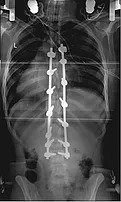
Transforaminal Lumbar Interbody Fusion (TLIF) is a spine fusion procedure performed from the back of the spine through a posterior incision. A minimally invasive version (MIS-TLIF) is now available and preferred at Pune Spine Institute for eligible patients, offering much faster recovery.
Key Advantages
What is TLIF?
In TLIF, the surgeon approaches the spine from the back through a posterior incision. The disc at the affected level is removed through a channel created in the foramen (neural opening), and a cage is placed in the disc space. Pedicle screws and rods are then placed to provide immediate stability while the bone fuses.
When is TLIF Recommended?
- Spondylolisthesis (vertebral slippage) causing nerve compression
- Degenerative disc disease with instability
- Recurrent disc herniation requiring fusion
- Adjacent segment disease
- Lumbar spinal stenosis with instability
Minimally Invasive TLIF (MIS-TLIF)
At Pune Spine Institute, MIS-TLIF is offered to eligible patients. This approach uses small percutaneous incisions rather than a large open incision: • 2 small stab incisions instead of a large midline incision • Tubular retractor system to access the spine • Minimal muscle disruption and blood loss • Faster recovery: walking same day, discharge in 2–3 days • Return to work: 2–4 weeks (vs. 6–12 weeks for open TLIF)
Recovery After TLIF
Traditional TLIF: • Hospital stay: 4–7 days • Return to work: 6–12 weeks MIS-TLIF: • Hospital stay: 2–3 days • Return to office work: 2–4 weeks • Full fusion: 4–8 months