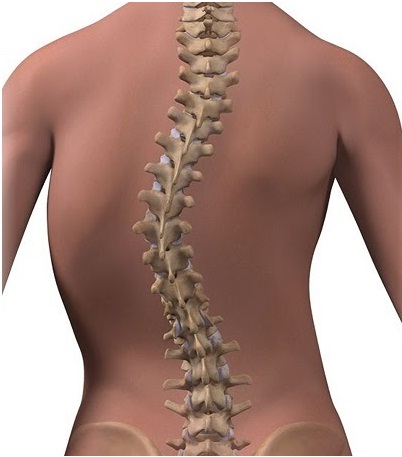

Scoliosis is referred to as sideways curving of the spine. An abnormal lateral curvature of the spine is characterized by a curve with an angle of 10 degrees or greater. Normal spine, when viewed from the front, forms a straight line. Most of the time it occurs in the adolescent age group and the cause is unknown — this is known as Adolescent Idiopathic Scoliosis. The majority of scoliosis occurs in females.
Different Types of Scoliosis
A) Idiopathic Scoliosis: Develops in childhood. Early-onset idiopathic scoliosis and late-onset idiopathic scoliosis are two types. Early-onset scoliosis affects children between the ages of one and nine. The earlier scoliosis develops, the more severe and disabling it can be. Early-onset scoliosis can cause serious lung problems. B) Adolescent Idiopathic Scoliosis: Also known as late-onset scoliosis, typically presents between 10 to 17 years of age. More common in females and mostly affects the thoracic (upper) spine and rib cage. Surgical procedure is often advised if the curve increases to 50 degrees in a growing spine. 90% of patients are able to return to routine activities by around 12 months post-operation. C) Adult Degenerative Scoliosis: Develops in adulthood from disc and facet joint degeneration. If one side of the disc degenerates faster than the other, the disc can tilt and this causes the spine to bend and curve.
What are the Causes of Scoliosis?
In approximately 80% of cases, the cause of scoliosis is unknown (Idiopathic). It usually develops when the patient's age is between 10 and 17 years old, roughly coinciding with the onset of puberty. Research into the exact cause of idiopathic scoliosis is still ongoing. Scoliosis can also be triggered by underlying medical conditions such as: • Muscular Dystrophy • Cerebral Palsy • Marfan Syndrome • Congenital vertebral anomalies
What are the Symptoms of Scoliosis?
Symptoms in Children: • The shoulders are two different heights • The head doesn't look centred with the rest of the body • One hip is higher than the other or protrudes from the body • The ribs are pushed out • When the child bends forward, the two sides of the back are at different heights Symptoms in Adults: • Uneven shoulders and/or hips • Bump in the lower back • Numbness, weakness, or pain in the legs • Trouble while walking • Difficulty in standing up straight • Fatigue / Tiredness • Short breath in severe curves • Bone spurs in the spinal joints
Treatment For Scoliosis
Scoliosis treatment depends on the patient's age, severity of the spinal curve, location of the curve, how quickly the curve is progressing, and whether the patient is still growing. A) Observation: Recommended when the curve is not large enough for non-surgical or surgical treatments. Regular monitoring with examination and radiological studies. B) Bracing: Non-surgical treatment comprising wearing an external brace for a recommended period (typically 2–3 years) to stop the curve from getting worse. Most effective in the growing spine. The more hours per day the brace is worn, the better the outcome. C) Surgical Treatment: Surgical procedures for scoliosis include spinal fusion — welding several vertebrae together to form a single segment of bone. Modern techniques using pedicle screws connected with two rods allow significant correction to be achieved. 90% of patients return to routine activities by approximately 12 months post-operation.
Case Images