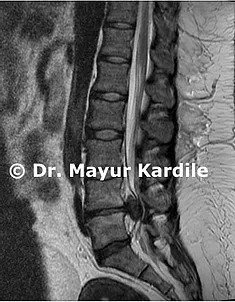
The outer fibres of the intervertebral disc are injured, resulting in a prolapsed (herniated) disc. The intervertebral disc is a soft cushion material (also known as the nucleus pulposus) that ruptures out of its normal boundaries and irritates the spinal nerves causing pain and numbness. Herniated discs (slipped disc) are very common in young and middle-aged adults. As much as 90% of cases can be treated with non-operative herniated disc treatment.
What Causes Herniated Discs?
The herniated disc can develop suddenly or gradually over a period of weeks or months. Sudden causes: • Falling from a significant height • Landing on your buttocks — transmits a huge amount of pressure across the spine • Bending and attempting to lift an object which is too heavy Gradual causes: • Ageing • Hereditary factors • Work or recreation-related activities • Lifting weights or twisting in a manner which puts pressure on the disc • Smoking • Obesity • Prolonged sitting (e.g., driving)
Most Common Symptoms of Slip Disc
• Back Pain: Often severe and sudden. Usually eased by lying still and worsened by sitting, moving, coughing or sneezing. • Neck Pain: In patients with slip disc in the cervical spine • Nerve root pain (sciatica): Shooting pain that travels from the lower back through the buttock and down the leg • Loss of control of bladder or bowel movements (Cauda Equina Syndrome — rare but needs immediate medical attention) • Numbness or tingling in the buttock, leg, or foot • Pain flowing down one or both arms or legs • Weakness in arms and legs
Diagnosis for Herniated Disc
• Doctor's Examination: History and thorough physical examination to identify the herniated disc • X-ray: To assess spinal alignment and rule out fractures • CT-Scan: For detailed bony anatomy • MRI Scan: Most accurate test to diagnose herniated disc — shows the disc, nerve compression, and surrounding structures
Non-Surgical Herniated Disc Treatment
At Pune Spine Institute, 80–90% of patients suffering from slip disc feel better with non-operative treatment and symptoms almost disappear. Typically the healing process takes 6–9 weeks. • Medication: Pain medicines prescribed depending on severity and pain experienced • Physiotherapy: Exercise under observation of a skilled spine physiotherapist plays a vital role. Exercises help in lowering pain by strengthening the muscles that support the spine. At Pune Spine Institute, the exercise program is tailor-made for each patient. • Epidural injections / nerve root blocks: An injection given around the sciatic nerve reduces inflammation and makes recovery more comfortable.
Surgical Treatment: Microdiscectomy
Surgery may be considered only if symptoms are very severe and have not settled during the 6–9 week conservative treatment period. At Pune Spine Institute, the preferred surgical technique is Microdiscectomy — minimally invasive microscopic removal of herniated disc fragment: • Fingernail-size incision • Microscope-assisted disc fragment removal • Spinal nerve decompression • Duration: 45 minutes • Patient walks same day • Discharge: Same day or next day • Return to office work: Within 1–2 weeks Dr. Kardile and the Pune Spine team have performed over 1000 microdiscectomies with excellent outcomes.