
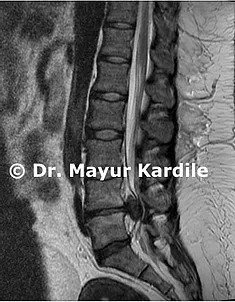
A Prolapsed Intervertebral Disc (PIVD), commonly known as a slip disc, herniated disc, or disc prolapse, is one of the most common spine problems. It is a condition where the disc between two vertebrae comes out of its normal position and irritates the adjacent spinal nerves. In severe cases, it can cause Cauda Equina Syndrome — compression of the bundle of nerves at the base of the spine — which is a medical emergency.
What is Cauda Equina Syndrome?
Cauda Equina Syndrome (CES) occurs when the cauda equina — the bundle of nerve roots at the base of the spinal cord — is compressed by a large disc prolapse. It is a medical emergency requiring urgent surgical treatment. Symptoms of Cauda Equina Syndrome: • Loss of bladder or bowel control • Saddle anaesthesia (numbness in the groin and inner thighs — the area that would contact a saddle) • Severe weakness in both legs • Severe low back pain If you experience any of these symptoms — seek emergency medical care immediately.
Symptoms of Prolapsed Intervertebral Disc
• Severe low back pain, often sudden in onset • Sciatica: Shooting pain that radiates from the lower back down through the buttock and leg • Numbness and tingling in the leg or foot • Weakness of leg muscles • In the cervical spine: arm pain, arm weakness, difficulty with hand tasks • In severe cases: loss of bladder or bowel control (emergency)
Treatment Options
Non-Surgical Treatment (for most patients): • Rest and activity modification • Pain medications and anti-inflammatories • Supervised physiotherapy • Epidural steroid injections Surgical Treatment (Microdiscectomy): Required in patients with Cauda Equina Syndrome (emergency), progressive neurological weakness, or failure to improve after 6–12 weeks of conservative treatment. Microdiscectomy at Pune Spine Institute: • Minimally invasive — fingernail-size incision • Microscope-assisted disc removal • Patient walks same day • Discharge: Same day or next day • Return to work: 1–2 weeks