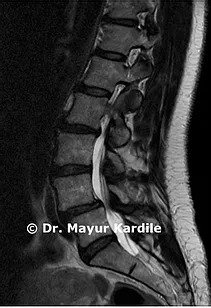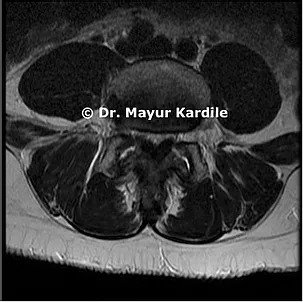
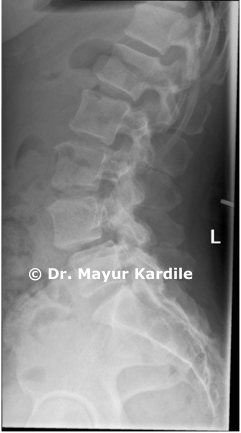
Degenerative Listhesis (also called degenerative spondylolisthesis) is slippage of one spinal vertebra over another due to degenerative changes in the disc and facet joints. Unlike isthmic spondylolisthesis which occurs in younger patients, degenerative listhesis usually affects people over 50 years of age. It commonly affects the L4-L5 level of the lumbar spine.
Causes and Risk Factors
• Disc degeneration (loss of disc height and hydration) • Facet joint arthritis and laxity • Female sex (more common in women) • Age over 50 • African American ethnicity • High segmental lordosis at L4-L5
Symptoms
• Chronic low back pain • Leg pain and neurogenic claudication (pain on walking relieved by sitting) • Numbness and weakness in the legs • Back stiffness • Difficulty walking long distances
Treatment
Non-Surgical: Physiotherapy, core strengthening, pain medications, epidural injections. Surgical: Decompression and fusion surgery when non-surgical treatment fails: • Minimally Invasive TLIF (MIS-TLIF) • Transforaminal Lumbar Interbody Fusion (TLIF) • ALIF or OLIF in appropriate cases
Case Images