Anterior Lumbar Interbody Fusion (ALIF) is a spine fusion surgery performed from the front of the body (anterior approach) through a small incision in the lower abdomen. Dr. Mayur Kardile is one of the rare spine surgeons in India fully trained and experienced in ALIF — a procedure that offers superior fusion rates and restoration of normal spinal anatomy.
Key Advantages
What is ALIF?
ALIF (Anterior Lumbar Interbody Fusion) is a type of spinal fusion surgery where the surgeon approaches the lumbar spine from the front (through the abdomen) rather than the back. This allows complete removal of the degenerated disc, insertion of a large fusion cage, and restoration of normal disc height and lumbar lordosis.
When is ALIF Recommended?
- Recurrent disc herniation (previous disc surgery at the same level)
- Severe disc degeneration with loss of disc height
- Spondylolisthesis (vertebral slippage) at L4-L5 or L5-S1
- Adjacent segment disease after previous fusion
- Failed back surgery syndrome requiring revision
- Degenerative disc disease causing severe back and leg pain
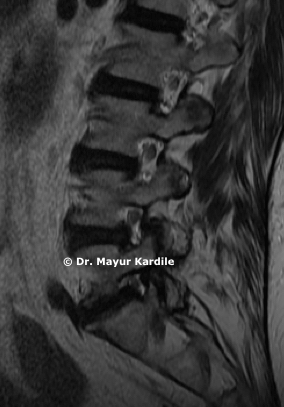
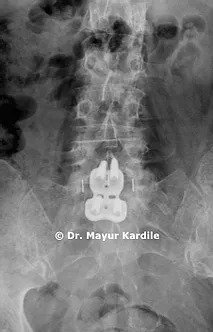
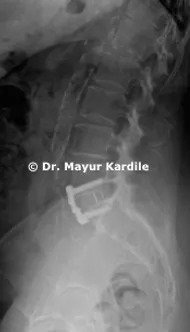
Case Example: ALIF for L5-S1 Recurrent Disc Herniation
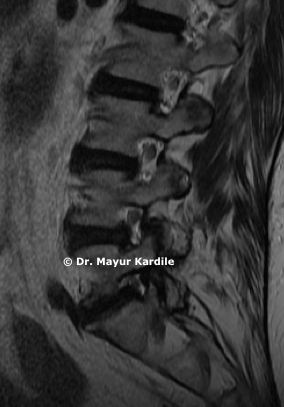
A 67-year-old lady presented with severe left-side leg pain and could barely walk. She had a previous L5-S1 discectomy 8 years earlier. MRI revealed recurrent disc herniation with foraminal stenosis on the left side. Dr. Kardile performed ALIF surgery: • Approach from the front — avoiding the scarred nerve roots from the previous surgery • Complete disc removal and large cage insertion • Restoration of normal disc height and lumbar lordosis • Result: Dramatic relief from leg pain; patient walking day 2; discharged day 3.
Advantages of ALIF Over Traditional Posterior Surgery
• Avoids the back muscles and previously scarred tissue • Allows complete disc removal and larger cage insertion • Superior restoration of disc height and lumbar lordosis • Higher fusion rates (larger surface area for bone fusion) • Very low risk of nerve injury (nerve roots are not directly manipulated) • Less post-operative pain from the surgical site • Effective for revision (repeat) spine surgery
Recovery After ALIF
• Patient walks day 1–2 post-surgery • Hospital stay: 3–5 days • Return to sedentary work: 2–4 weeks • Return to physical work: 3–6 months • Full bony fusion: 4–8 months • Post-fusion: No activity restrictions once fusion is confirmed
Case Images