
Cervical Spondylotic Myelopathy with Kyphosis
Published by Dr. Mayur Kardile — Pune Spine Institute
Case Overview
A 60-year-old gentleman presented with gradually progressive unsteadiness while walking. He had developed spasticity in his lower limbs and was unable to maintain his balance, affecting his daily activities significantly.
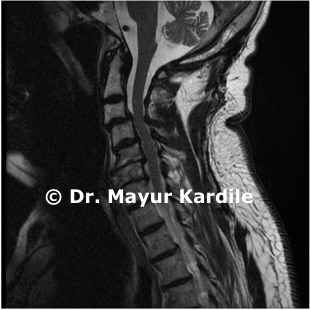
MRI revealed degenerative changes in the cervical spine with compression of the spinal cord from C3 to C7, causing cervical myelopathy.
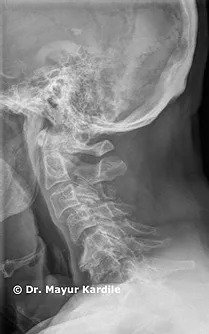
X-ray of the cervical spine revealed kyphotic alignment — the cervical spine was curving in the wrong direction, which made the cord compression worse and prevented simple decompression from being effective.
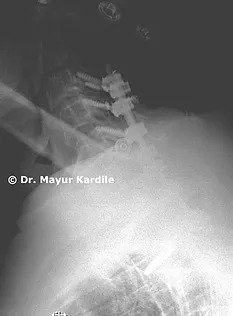
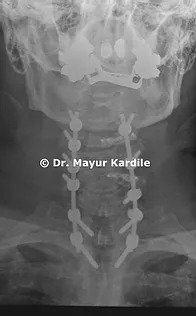
The patient was operated with C3 to C7 Laminoplasty with Posterior Instrumented Fusion from C3 to T2. This two-pronged approach decompressed the spinal cord and restored the normal lordotic alignment of the cervical spine.
The patient had gradual recovery from gait unsteadiness and spasticity over 3 months. This case demonstrates that cervical myelopathy surgery must address both the compression and the alignment to achieve optimal results.
Key Case Highlights
- 160-year-old with progressive gait unsteadiness and lower limb spasticity
- 2MRI: C3–C7 spinal cord compression (cervical myelopathy)
- 3X-ray: kyphotic cervical alignment complicating the condition
- 4C3–C7 Laminoplasty + Posterior instrumented fusion C3 to T2
- 5Both decompression and alignment correction were needed
- 6Gradual recovery from spasticity and gait instability over 3 months
Facing a Similar Spine Problem?
Get expert opinion from Dr. Mayur Kardile — Pune's leading spine surgeon
Book a Consultation
Consult Dr. Mayur Kardile — Specialist in Complex Spine Surgery
+91 7774040002Request Appointment
Dr. Mayur Kardile
MS Orth | DNB | MCh (Toronto) | FRCSC
Fellowship-trained spine surgeon from Toronto. Trained in North America with expertise in complex deformity correction, minimally invasive surgery, and revision spine procedures.
View Full Profile