
Minimally Invasive SI Joint Fusion Surgery
Published by Dr. Mayur Kardile — Pune Spine Institute


Case Overview
Minimally Invasive SI Joint Fusion Surgery is performed in carefully selected patients with sacroiliac joint dysfunction and pain that has not responded to conservative treatment.
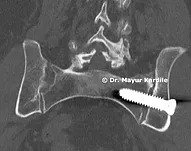
The procedure involves decortication of the SI joint surface and placement of 2 large titanium screws across the SI joint to achieve solid fusion. All of this is accomplished through a small 3 cm incision on the buttock area, with minimal blood loss.
A specially designed surgical system guides the instruments to prepare the bone and facilitate placement of titanium implants across the sacroiliac joint. During surgery, fluoroscopy (real-time X-ray imaging) is used to ensure precise implant placement.
The procedure is performed under general or spinal anesthesia. In properly selected patients, this technique yields gratifying results — patients experience significant relief from sacroiliac joint pain and can return to normal activities.
The sacroiliac joint connects the sacrum (base of spine) to the pelvis and transmits load between the upper body and legs. When this joint becomes dysfunctional or arthritic, it causes pain in the lower back, buttock, and leg that can mimic disc-related pain.
Key Case Highlights
- 1Performed for sacroiliac joint dysfunction not responding to conservative treatment
- 2Procedure: decortication + 2 titanium screws across SI joint
- 3Only 3 cm incision on the buttock — minimal blood loss
- 4Fluoroscopy-guided for precise implant placement
- 5General or spinal anesthesia
- 6Gratifying results in properly selected patients
Facing a Similar Spine Problem?
Get expert opinion from Dr. Mayur Kardile — Pune's leading spine surgeon
Book a Consultation
Consult Dr. Mayur Kardile — Specialist in Complex Spine Surgery
+91 7774040002Request Appointment
Dr. Mayur Kardile
MS Orth | DNB | MCh (Toronto) | FRCSC
Fellowship-trained spine surgeon from Toronto. Trained in North America with expertise in complex deformity correction, minimally invasive surgery, and revision spine procedures.
View Full Profile